This bridge begins as a handful of grass
You can pull grass out with one hand. Here, people cross a river on it.
Start with the unfinished part
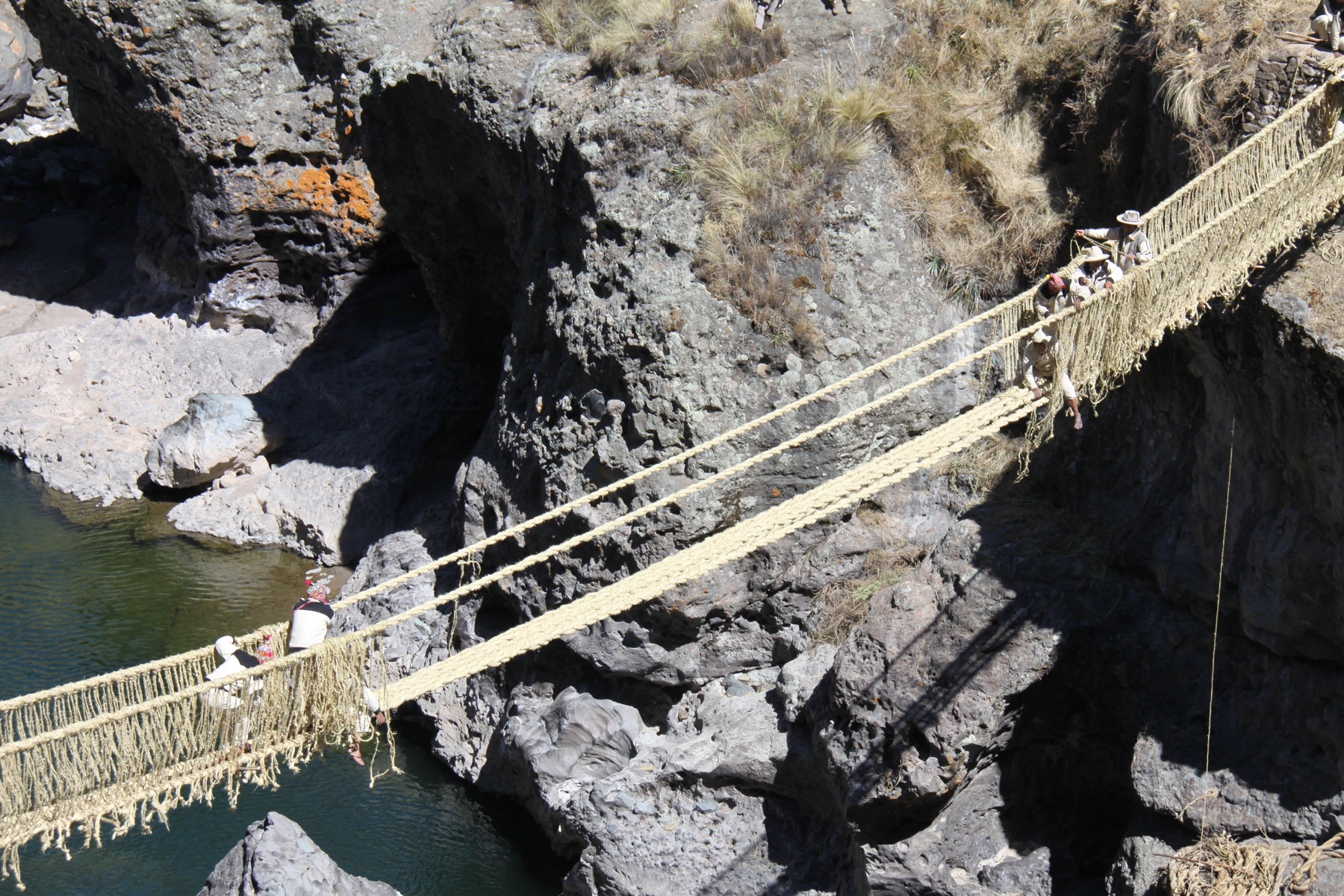
Follow the bridge across the photograph. Woven sides are already in place near the ends. Towards the middle, there are exposed cables and people working on them. You can see straight through to the gorge below. This photograph from 2014 catches the bridge being made.
Q’eswachaka crosses the Apurímac River in the Peruvian Andes. Its traditional annual renewal begins well away from that drop, with plant fibres that can still fit into a pair of hands.
The same idea, getting larger
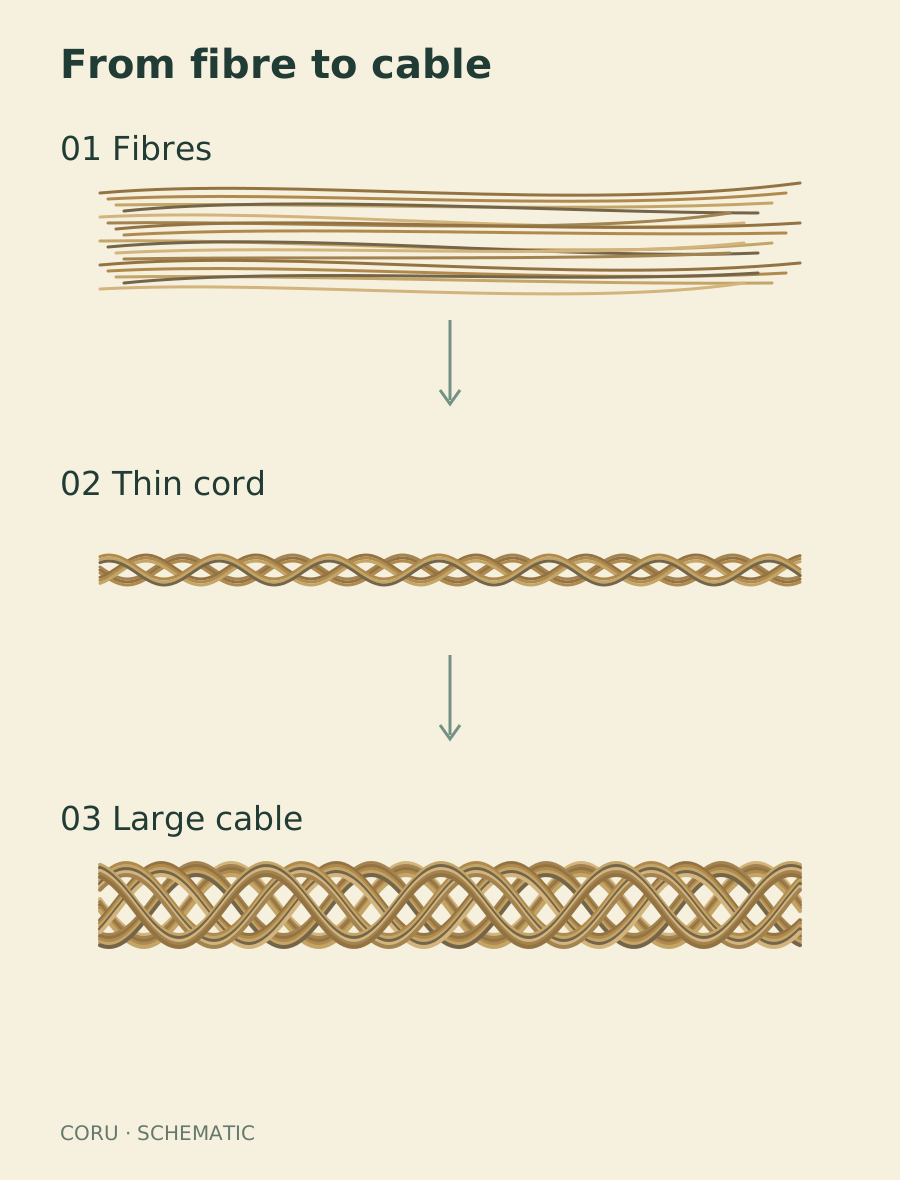
Families prepare thin cords. These are twisted together into thicker ropes, which are braided into large cables. Both UNESCO and the Smithsonian’s documentary describe this sequence. At first, one person can hold the work. Later, pulling out a cable takes a whole group.
There is no moment when the grass turns into some different material. What changes is its arrangement: many fibres become one long, connected structure. A small finished object becomes the raw material for the next, larger one.
A path held in tension
It is easy to mistake a rope’s flexibility for weakness. But bending something and pulling it apart are different tests. A loaded cable is held in tension, passing forces to supports at its ends.
At Q’eswachaka, four main cables form the base underfoot; another two serve as handrails. That detail matters: the floor rests on the lower cables themselves. There is no need to add the tall towers and separate roadway of a modern suspension bridge in your imagination.
Look back at the photograph. Where the woven sides are still missing, the arrangement is particularly clear. The lines of the crossing are already there, although its familiar outline is incomplete.
The old bridge helps the new one arrive
The Smithsonian film shows an easy-to-miss transition. The first cable of the new bridge is taken across using the old bridge. Only then is the old woven structure released to fall into the river.
The new cables are pulled tight and secured at stone bases. The builders start weaving from opposite banks and work towards one another in the middle. The photograph makes that distance tangible: between what has been made on each side, work still remains.
We often picture the preservation of an old structure as a struggle to retain its original material. Here, renewing the material is itself part of the tradition.
Four communities hold more than cables
UNESCO names four Quechua communities: Huinchiri, Chaupibanda, Choccayhua and Ccollana Quehue. Ritual ceremonies accompany the shared work, which ends in a celebration. The skills are passed on within families.
In an account published by the Smithsonian in 2015, bridge master Victoriano Arizapana Huallhua describes teaching children and young people. That testimony suggests another task for the bridge: giving the next generation a chance to work alongside people who know how.
Return to the people in the photograph. Without them, there would be fibres, stones and a distance between two banks. To make those things into a path again, people must know what to do—and come together to do it.
Q’eswachaka continues through more than footsteps from one bank to the other. It continues whenever someone learns to make the next rope.
