Find the mountain first: looking at Hokusai’s Great Wave
The wave takes your attention at once. Try beginning with the small mountain in the distance, then find the people: the familiar image becomes a scene holding several different scales at once.
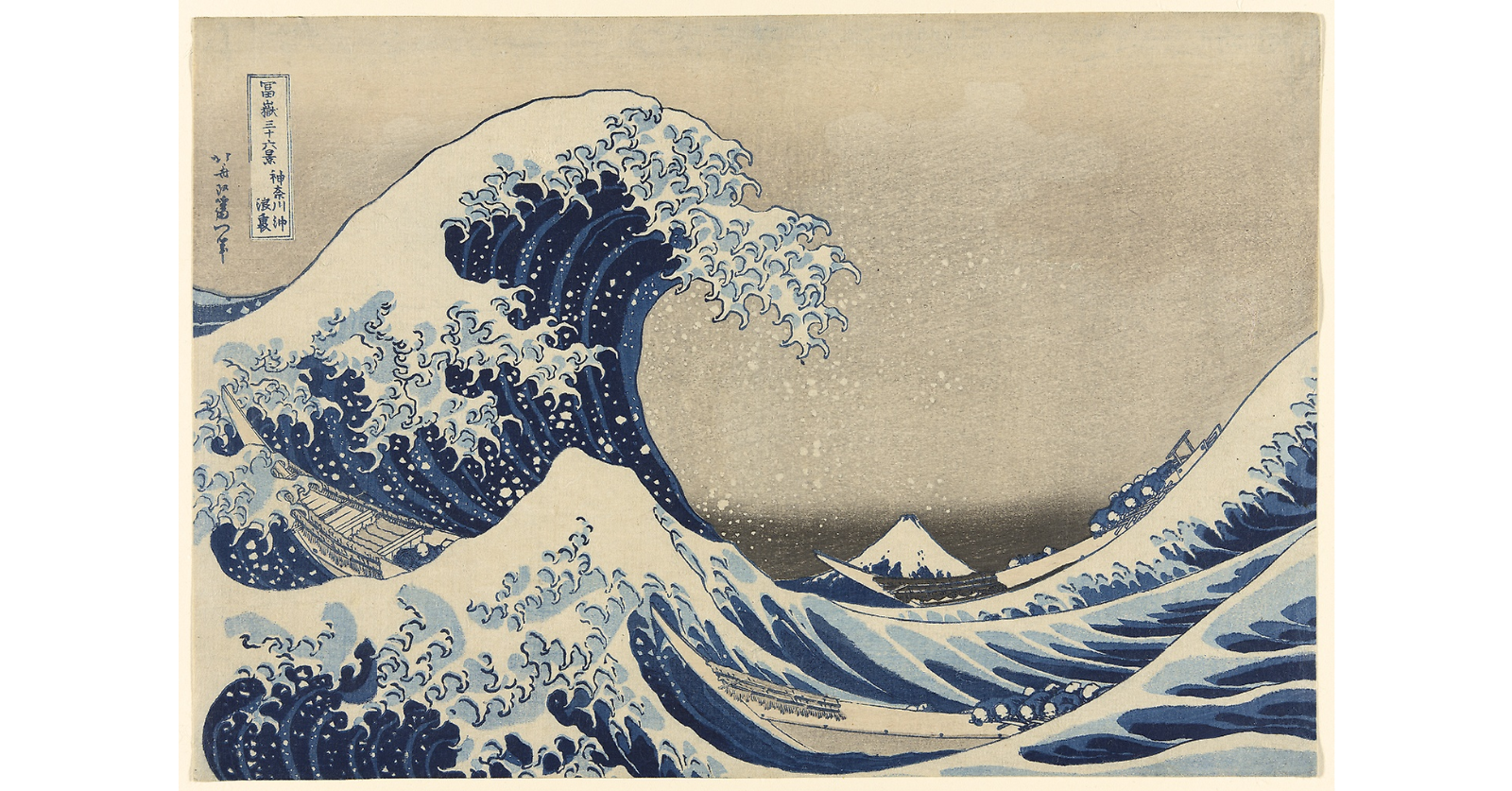
The mountain you might miss
Look just right of centre, low down above a boat: the small white triangle with a blue base is Mount Fuji. A space of pale sky surrounds it. You can pause here for a moment before returning to the enormous crest on the left.
Now find the nearer wave to the mountain’s left. Its white peak also makes something like a triangle, but a much larger one. Moving your gaze between these two shapes produces a strange shift in scale: the distant mountain looks small, while the water close to us becomes a mountain. This is a visual comparison, not a claim about the wave’s actual height.
The wave has an edge
Follow the top line of the large wave. It rises from the left, bends over the dark blue mass and breaks into white curls. Each has its own blue outline. From a distance, this is one crest; up close, it becomes many small curves pointing down.
Then look at the pale dots beneath the crest. They stand apart, while the blue water gathers into broad bands. Our reading is of a moment of separation: the large form still holds together, but its edge is already scattering. Lines and the spaces between them are enough to suggest this; the movement itself is imagined.
The people give us a measure
Three long boats run through the water. One stretches across the foreground, another appears on the left beneath the large crest, and the third lies farther back on the right, in front of Fuji. Begin with their pale, elongated hulls: they echo the curves of the water and can disappear among the waves.
Now find the small pale heads above the dark blue clothing. The people crouch down; their bodies make no prominent upright lines. Beside them, the white curls of the crest begin to look especially large. The same line that was a beautiful pattern a moment ago may start to feel threatening.
Stay for a second with the boat in front of the mountain. People, water and Fuji meet in one small area; their sizes on the sheet keep sending your gaze from near to far.
Return to Fuji
Hokusai included this print in Thirty-Six Views of Mount Fuji. The Art Institute of Chicago dates it to 1830–1833. The mountain is indeed here, although the familiar name The Great Wave directs our attention towards the sea before we even look.
Look at the white peak again. You might read it as a still point among curves, spray and crouching figures. That is our proposed interpretation, rather than a decoding of one definitive artistic intention. Perhaps your gaze keeps returning to the boats instead; now it has a reason to linger there too.

