Two versions. One melody. Find the switch.
Play A, then B at the same volume. One part has been replaced; the rest of the recording is identical. Find the switch.
Version A
Transcript
No speech. A soft plucked melody, quiet accompaniment and four low notes. Phrases start at 0.4, 3.4, 6.4 and 9.4 seconds. The final melody note starts at 10.4 seconds; sound fades by 15.5.
Version B
Transcript
No speech. A soft plucked melody, quiet accompaniment and four low notes. Phrases start at 0.4, 3.4, 6.4 and 9.4 seconds. The final melody note starts at 10.4 seconds; sound fades by 15.5.
Which part is your suspect?
Only one part was replaced between A and B. Choose the part you think changed.
Answers and explanations
- The melody—the upper notes: The upper layer is literally identical: the same recording of the melody and quiet accompaniment was added to both mixes. You can hear it alone below.
- The rhythm—durations or pauses: The entrances, durations, pauses and tempo stay the same. Neither version was sped up. The change is in the low part.
- The bass—the low notes: Yes. Four low Cs were replaced by four As, three semitones lower. The upper layer stays the same. The isolated parts and exact note map are below.
The switch is underneath
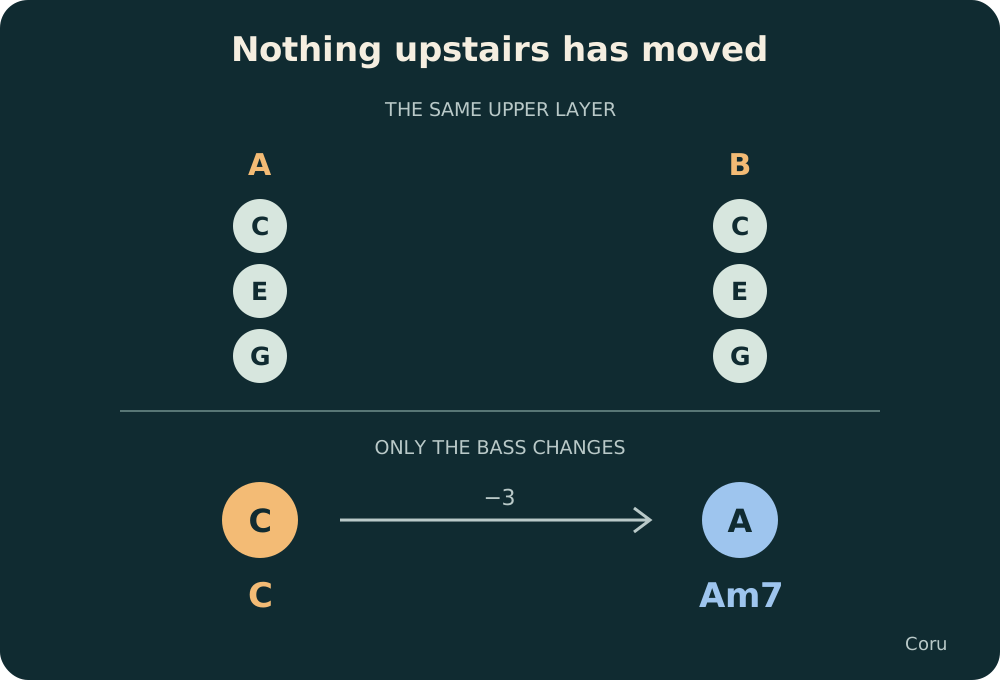
In A, the low note is C. In B, it is A, three semitones lower. The pitch changes at each of the four bass entrances; its rhythm and instrument sound stay the same. The melody and quiet chords above it come from one identical recording.
This is not an original-versus-remix comparison with extra changes to volume, tempo and effects. Both versions use one shared gain. Subtract each version’s bass and the same upper layer remains—down to every audio sample.
Take it apart: the identical upper layer, without bass
Take it apart: the identical upper layer, without bass
Transcript
Instrumental miniature with no speech or external recordings. The first 0.4 seconds are silent. A soft plucked melody then uses only C, E and G above a gentle accompaniment made from those same notes. Four phrases start at approximately 0.4, 3.4, 6.4 and 9.4 seconds. The final melody note begins at 10.4 seconds; the sound then gradually fades to the end of the file. There is no bass. The melody, quiet accompaniment, their gain and their spatial effect are identical to the upper layer in both complete versions.
Take it apart: bass alone—C, then A
Take it apart: bass alone—C, then A
Transcript
No speech. One low C3 sounds at 0.4 seconds and decays, followed by a pause. One low A2 sounds at 4.2 seconds, three semitones lower, and fades by 7.1 seconds. These are short extracts from the bass parts with gently faded ends, without the upper voices.
Why three upper notes are enough
The upper layer uses C, E and G. Together, those notes make a C-major triad, written C. The low C in version A reinforces its root.
In version B, an A appears underneath. The collection becomes A, C, E, G: an A-minor seventh chord, Am7. It contains the minor triad A–C–E plus G, a minor seventh above the root. Every previous upper note remains in place; its relationship to the new bass changes.
This map describes the chords of our miniature. It does not imply that the lowest note always determines a whole chord, or that one bass note establishes the key of any piece. We deliberately chose compatible notes and a simple texture so the switch would be available to hear.
Go back to the door
Picture a short shot: someone stands at an open door, holding a key. Have they just arrived—or are they about to leave? We wrote two versions of one miniature for this scene. There is no correct interpretation of the scene. For now, notice what you hear.
Play A, then B, again. This time, listen beyond “happy or sad”: which note feels like an anchor, and how does the last phrase finish? If the difference feels small to you, that is a valid impression too. This is not a hearing test, and no emotion has been prescribed.
Choose one version for coming home and the other for leaving. Or keep both for the same event and change only what the viewer knows about the person with the key. Music need not supply a new melody to give a scene a different reading.
You can play the versions to someone else without these labels. Compare your stories afterwards. The technical puzzle about the bass has a correct answer. The scene behind the door does not.
About the recording
This is an original Coru miniature with synthesized plucked timbres. It uses no borrowed melodies, samples or recordings. Limiting the upper material to three note names does not prescribe someone else’s composition. Each player offers the source WAV.
A small speaker may make the low notes less noticeable. If you wish, try headphones at a comfortable volume. The descriptions and diagram also explain the change without listening.