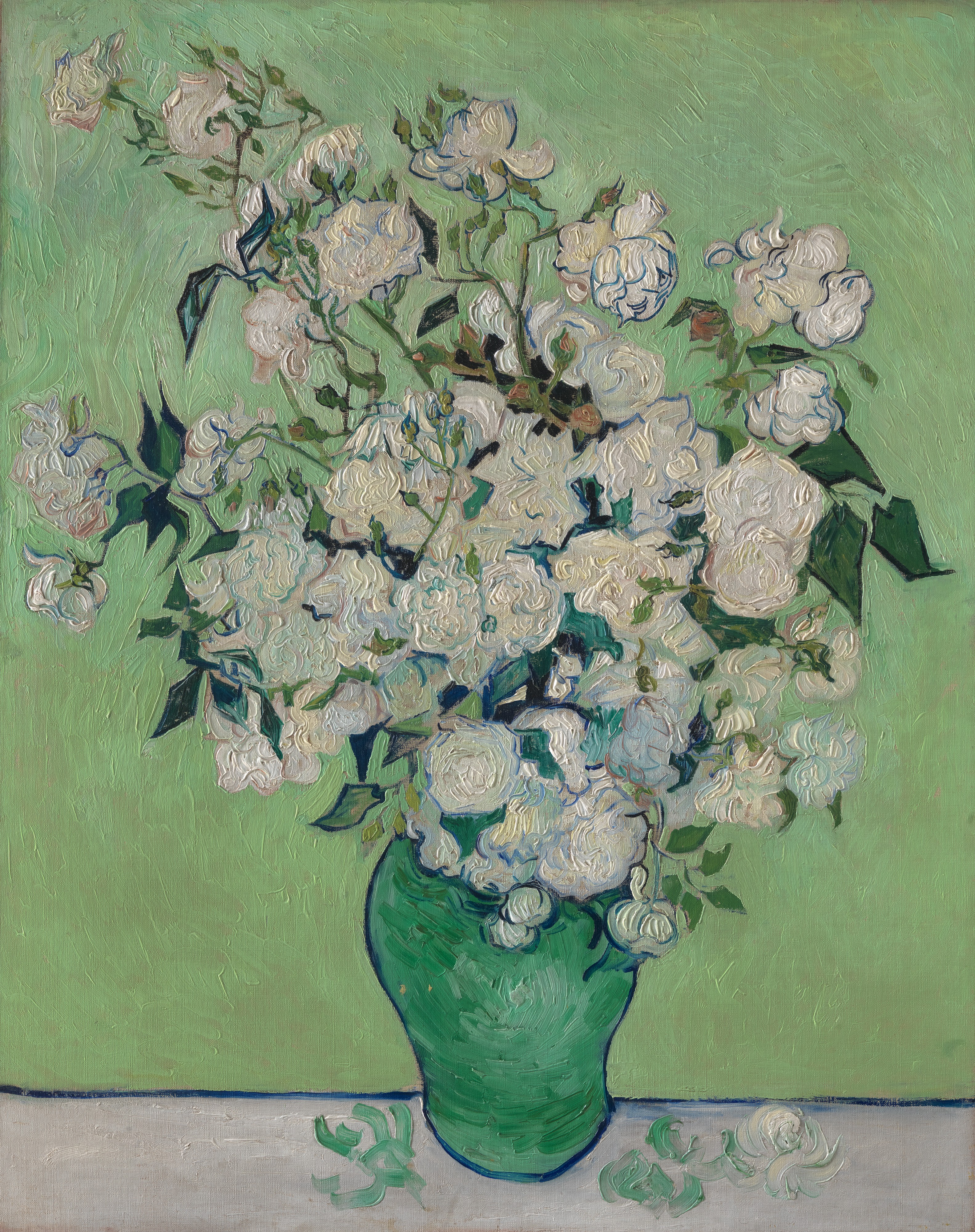
Van Gogh painted pink roses. We see white.
The bouquet outlived its flowers. Not all of its colors survived.
The same word twice
Look at the bouquet before reading the letter. Pale petals coil around dark centers; green fills almost every gap. It is easy to remember this as a picture of white flowers against green.
On May 13, 1890, Van Gogh writes to his brother Theo from Saint-Rémy. Among his travel arrangements, he mentions a canvas he has just finished. The French contains the same word twice: “roses roses”—pink roses. He then specifies a yellow-green background and a green vase.
This is not simply a painter and a present-day viewer giving different names to one shade. The letter preserves a color that the painting has largely lost.
Look for what remains
Return to the left edge of the bouquet, around its middle. Beneath the pale strokes of a drooping flower, a pinkish band is still visible. The whole bouquet has not become uniformly white.
The museum identifies surviving pink in the petals and along the tabletop. Faint tones will look different on different screens; a photograph cannot tell you what a pigment is made of. Yet looking for a trace is more absorbing than merely accepting the label “once pink.”
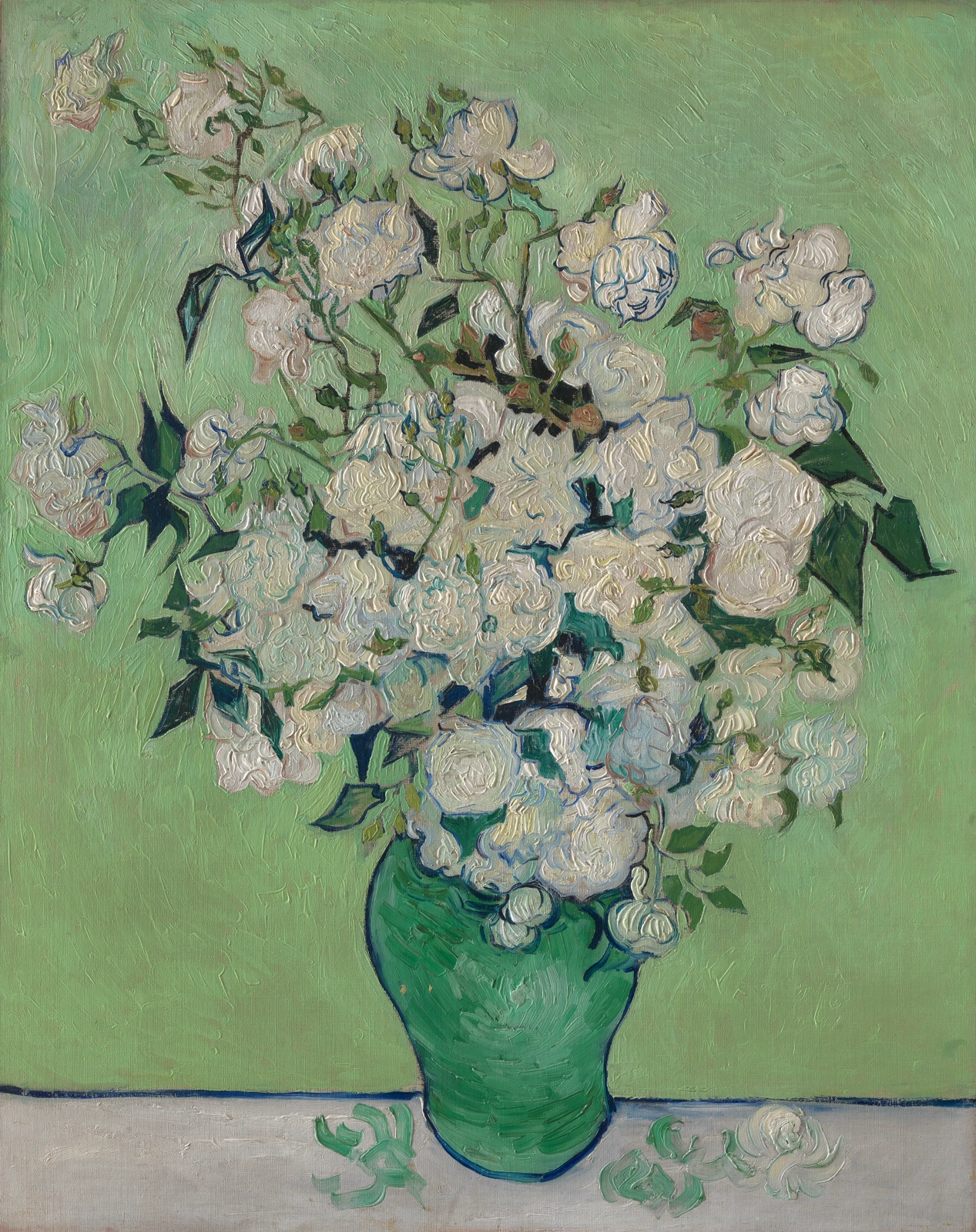
The full museum photograph is linked in the sources. The image here shows the same painting without added brushwork or digitally restored color.
One color leaves. The relationship changes.
Light-sensitive red lake pigments faded. In a mixture with white, the loss of red leaves pink looking almost white. Violet passages in other bouquets from the same series have changed too.
Now mentally separate the drawing from the color. The vase is still in place; the curves of stems and the ridges of brushwork remain. But colors meet one another differently. The museum’s study identifies the contrast of pink and green as central to this upright bouquet.
This is an easy kind of loss to overlook: what remains is still a complete, beautiful painting. There is no empty hole marked “color missing here.”
Why there is no “put it back” button
The Met’s researchers combined paint analysis, documents and early reproductions to make digital reconstructions of the four bouquets. These suggest broad color relationships; the precise variations of pink and violet cannot be recovered with certainty.
It would be easy to fill the white petals with one persuasive pink. It would then be harder to see where evidence ends and our own choices begin.
So the last step is to look at the same photograph again. First you saw a white bouquet. Now it contains a missing color. Not one pixel has changed; what you know how to notice has.