Three shots, two stories: try a film-editing experiment
An empty chair, a face, a second cup. Make two nine-second edits from the same footage, then separate what you see from the story you infer.
The chair has not moved. Has the story?
You have three shots: an empty chair, a person looking towards it, and a hand setting down a second cup. Nobody arrives. Nobody leaves. Can these scraps suggest both an absence and an invitation? Try changing their order before you add a line of dialogue.
This is a small editing exercise, with no correct emotion to guess. You can start with three paper cards and imagine the cuts. For the fuller version, film three silent clips on a phone. Keep the same clips in both edits: the experiment is in the arrangement.
Make three simple shots
Use a table, two chairs and two empty cups. Film indoors with steady light. Keep the phone still for each shot; change its position between shots. Label the clips A, B and C in your notes, rather than putting labels over the pictures.
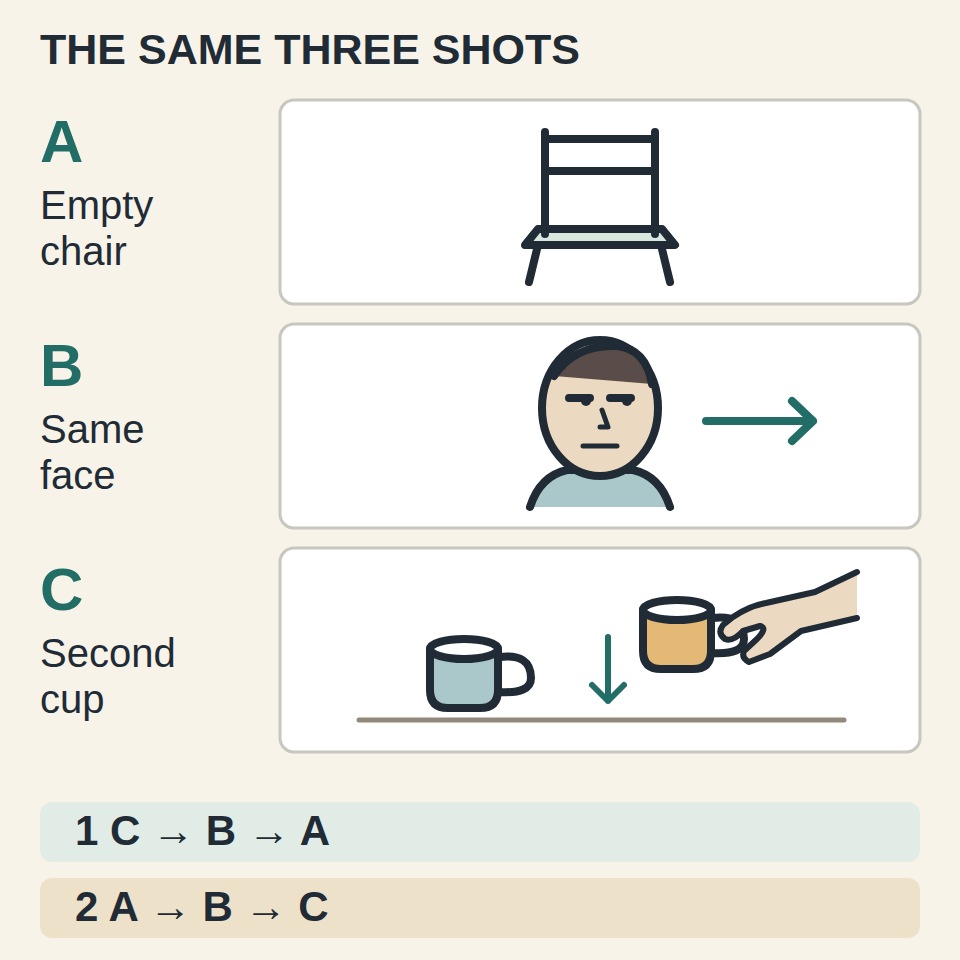
- A — The empty chair. Frame only the unoccupied chair opposite the person. Keep the tabletop out of view, so the number of cups is not visible.
- B — The face. Film the seated person looking towards that chair, just outside the frame. Ask for a relaxed expression, without a deliberate smile or frown. Use this exact recording in both versions.
- C — The second cup. Show one cup already on the table. A hand places another beside it, then moves away. Keep faces and chairs outside this frame.
Build two nine-second sequences
Trim each clip to three seconds, allowing the cup movement to finish inside C. These are convenient working lengths, not a scientific requirement. Join the clips with straight cuts. Keep the sound muted and add no music, fades, captions or slow motion.
Edit 1 is C → B → A: second cup, face, empty chair. Edit 2 is A → B → C: empty chair, the same face, second cup. Both last nine seconds. If you are using cards, turn them over one at a time in those orders; that tests your storyboard, not the experience of watching moving images.
Before reading the next section, write one sentence about each version. What seems to have happened, and what do you expect next? If you already know the proposed readings, ask someone who has not read them to describe the clips first.
Two possible stories
In C → B → A, the second cup prepares a place for someone; the final empty chair leaves that expectation unanswered. You might imagine a guest who has not come, a familiar ritual, or someone remembering an absent person. The last shot gives you an absence to sit with.
In A → B → C, the empty chair becomes a space the person appears to notice and then prepare. The second cup can feel like a decision: perhaps someone is about to be invited. The ending offers an action instead of an empty place.
Those are proposals, not results collected from viewers. You may read both versions as ordinary preparation for tea. The images establish an empty chair, a look and a cup being placed. They do not establish a death, an argument, a promise, or even that a guest exists. Notice how much story you supplied.
What this has to do with Kuleshov
The Kuleshov effect concerns the influence of surrounding images on the emotion viewers attribute to a face. It is often taught through a story about the same neutral face combined with different scenes. The original footage is lost, and its famous audience reactions should not be treated as a modern controlled experiment.
A 2016 study by Barratt and colleagues found context-sensitive judgments of faces using a controlled design. A 2024 study by Cao and colleagues also found changes in emotional judgments using purpose-shot film sequences. These findings support an influence of context under the tested conditions; they do not make every interpretation automatic or identical.
Our exercise changes the order of three shots and asks about a story. It is inspired by that attention to context, but it does not replicate those studies or measure the Kuleshov effect.
Ask for evidence inside the picture
Show an edit without explaining the intended mood. Ask “What happened?” before asking about feelings. Then ask which visible detail led to that answer. This separates a useful clue from an association you did not put on screen.
If possible, let different people see different versions first. Anyone who watches both already knows the ingredients on the second viewing. A few responses can help you revise this scene; they cannot prove how audiences in general think.
Copy this editing worksheet
text
EDIT ORDER: ________________________
What I can actually see: ___________
What I think happened: ______________
The shot that led me there: _________
Another possible reading: __________
What I expect in the next shot: _____
One change to try next: _____________
Keep separate notes for the two edits. A different answer is information about the scene, not a wrong response.
If both edits feel the same
First check that the second cup and the empty chair are easy to recognise. Then check that the gaze in B plausibly points towards the chair. If the person is smiling broadly, that performance may dominate both readings.
Keep a copy of the first pair. Change one thing next: hold the final shot longer, try a different expression, or replace the cup action. Say which variable changed. Your useful discovery may be a stronger story, or simply the point where a cut invites more meaning than the footage actually shows.