They read a 300-year-old letter. The seal stayed shut.
A sealed letter presents two puzzles: what does it say, and how was it closed? A dental scanner and a digital unfolding reveal one answer without destroying the other.
Two instructions
Imagine being handed an old letter and two instructions: find out what it says; do not open it. Scissors would solve the first problem in seconds. They would also destroy part of the answer.
In 2021, researchers read a letter dated 31 July 1697 without breaking its seal. The letter had never reached its intended recipient. More than three centuries later, its words became readable while the paper remained folded shut.
Before we get to those words, there is a question worth sitting with. What could the unopened package tell you that the message inside could not?
The envelope is the message
Picture a modern letter: a sheet inside another piece of paper. The outer wrapper gets torn; the inner sheet survives.
A locked letter can be a different object. The written sheet is folded and secured so that it becomes its own envelope. A flap can tuck under another layer. A slit can receive a strip of paper. Adhesive or a lock can hold the arrangement together. The sender builds the closure into the thing being sent.
“Letterlocking” is the modern name for this historical practice. It covered many methods, not one secret fold. Some secured a packet with folds and tucks alone. Different arrangements offered different kinds of protection; calling something a locked letter does not mean it was impossible to open secretly.
Now reconsider the scissors. Opening the packet changes which layer sits above which, and releases tucks that may leave little trace. A flat sheet can retain creases yet lose the exact arrangement that made it work. The words survive; part of the sender’s handwork may not.
The research team wanted both.
A letter waiting for somebody
The letter belonged to the Brienne Collection, a postmaster’s trunk of undelivered correspondence associated with The Hague. It is the sort of archive that reverses the usual reason for keeping a letter. These papers survived together because delivery had failed.
Our packet has the catalogue identifier DB-1627. Before the computational analysis, the researchers knew the intended recipient’s name from the outside. They did not yet know the full message within.
That distinction makes the problem wonderfully concrete. There was no need to invent a lost alphabet. The writing was there. The obstacle was the paper sitting on top of it.
The detour through a dental laboratory
One part of the solution came from Queen Mary University of London’s dental research labs. A sensitive X-ray microtomography scanner developed for studying teeth could also detect small amounts of metal in certain historical inks.
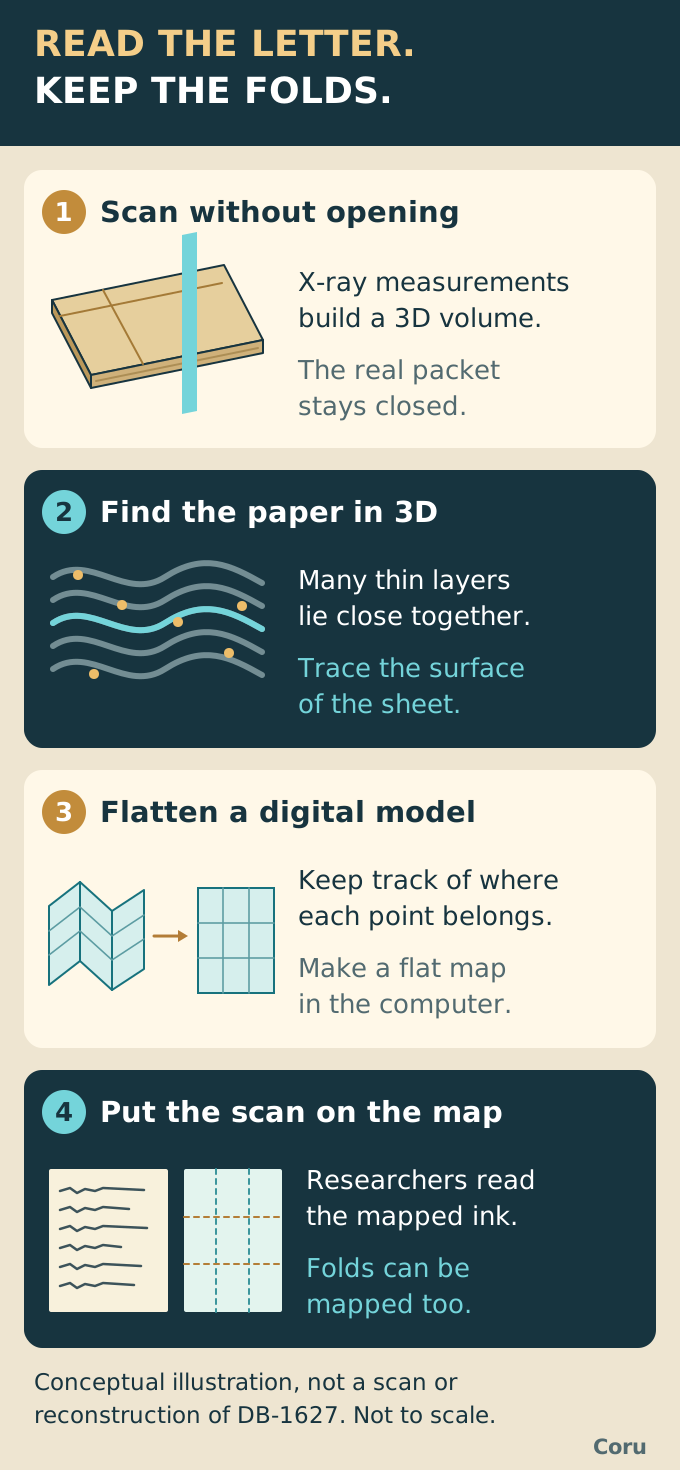
Instead of making a single photograph, the scan recorded the packet as a three-dimensional volume. Different materials produced different signals. The writing could become visible in the data, but that did not make the document conveniently readable: its lines still followed folded, overlapping surfaces.
Imagine photographing the pages of a book after pressing them into a crumpled ball. Seeing the ink and putting the sentences in reading order are separate problems. The scanner supplied the first kind of information. The team still needed a way to lay out the page.
Follow the paper, not the alphabet
The computer’s task was geometric. It traced the thin surfaces of the paper through the scan, built a digital representation of them, and calculated a flattened arrangement. The scan’s ink information could then be mapped onto that surface.
A useful way to picture it is a road map on a folded sheet. The road itself has not changed. What you need is a relationship between each place on the folded sheet and its position when laid flat. Once you have that relationship, you can move the recorded marks with the surface.
The researchers could also map the folds, making the structure available for study alongside the writing. The original packet did not perform the spectacular unfolding you may see in an animation. Its digital counterpart did.
Check the recovered page
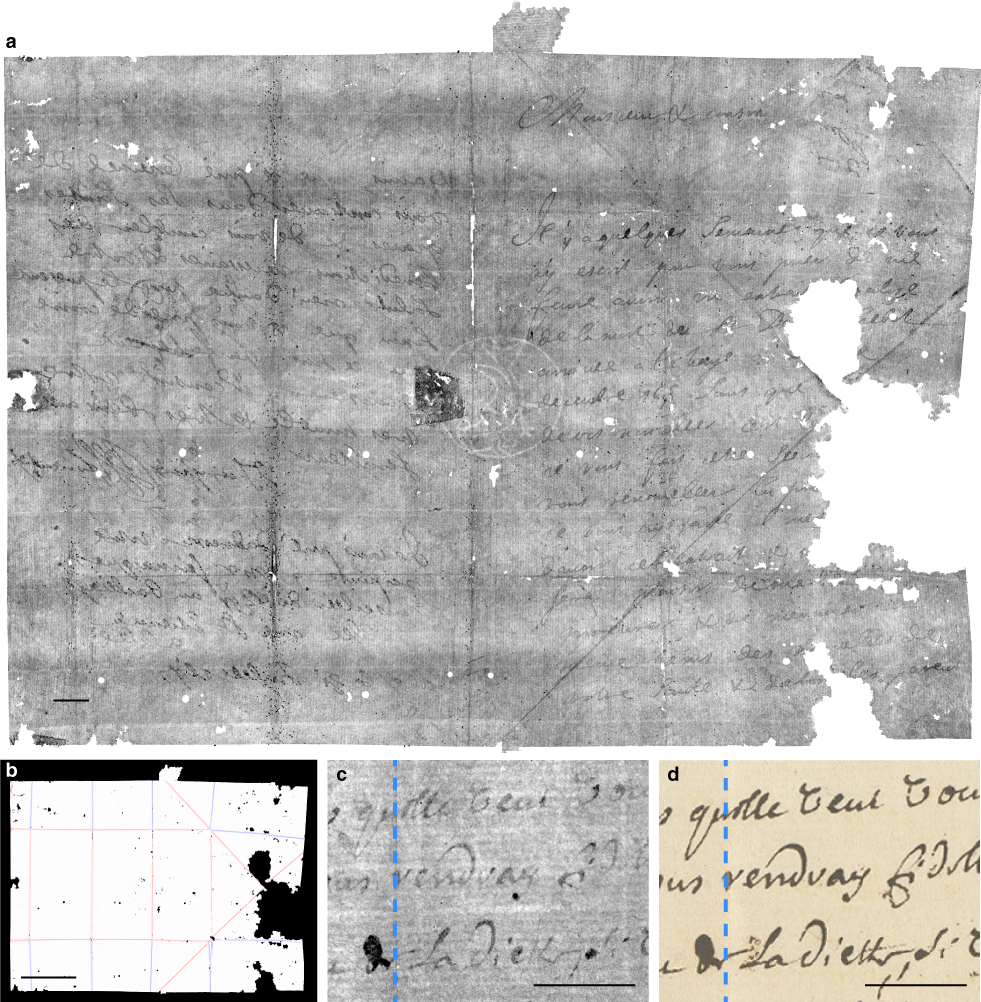
This was not a machine guessing what a seventeenth-century cousin probably wanted to say. It produced images that people could read. Nor were the results flawless: the study describes missing pieces and incorrectly joined regions, including in DB-1627. A reconstruction needs checking, just as a transcription does.
For a comparison with a physical document, the team also reconstructed an already opened letter and compared the result with a photograph. An impressive animation was not the whole test.
In the research figure below, the large panel (a) shows DB-1627’s recovered writing; the smaller map (b) shows its folds. Panels (c) and (d) belong to that other, already opened letter, DB-2040: a reconstructed image beside a photograph. Those are different pieces of evidence, not four views of the same packet.
So what was inside?
A request for paperwork.
Jacques Sennacques was writing to his cousin Pierre Le Pers, a French merchant in The Hague. He wanted a certified copy of the death notice of Daniel Le Pers.
After the sealed package, the dental scanner and the unfolding algorithm, that can feel like an anticlimax. It is also what makes the discovery recognisable. Somebody needed a document from somebody else. The delivery system failed. The task outlived the people waiting for it.
We do not need to turn the letter into a spy thriller to make that matter. Its ordinary business is evidence of a life. The researchers recovered it without sacrificing the small paper construction through which that life had tried to communicate.
Try the problem with two scraps of paper
Here is a small observation exercise, not a reconstruction of DB-1627.
Take two equal rectangular scraps. Write the same short message in the middle third of each. Fold both into thirds, but change the order.
For the first, fold the top third down over the middle, then fold the bottom third up over it. For the second, fold the bottom third up first, then the top third down. In each packet, notice which flap you folded last: that is the one lying on the outside.
The closed rectangles have the same outline and contain the same words. Yet their layers are arranged differently. Sketch which flap lies outside each packet, then unfold them. Both sheets have the same two crease positions. Those lines alone do not tell you which flap was on top.
You have not recreated historical security or tested a scanner. You have separated two questions that are easy to confuse: “What was written?” and “What did someone do with the sheet?” The researchers’ own imaging page, linked below, offers historical models and animations if you want to explore actual letterlocking. Its DB-1538 animation shows a different packet from the DB-1627 letter described here.
The message can now be read. The seal can stay shut. What once looked like a choice between knowing and preserving has become a way to do both.
Sources & further reading
- Original research: virtual unfolding of locked letters (Nature Communications, 2021)
- MIT Libraries: why the folded letter matters
- Queen Mary University of London: the dental scanner used to read the letter
- Letterlocking research team: what letterlocking means
- See historical models and virtual unfolding animations (Letterlocking research team)
- King’s College London: the letterlocking research project
- Coru video: They Read This Letter Without Opening It (English, YouTube)