The Night Watch did not fit between the doors. So they cut it.
People disappeared, yet the painting still looks complete. A small seventeenth-century copy shows what went missing with the edge of the canvas.
Start at the edge
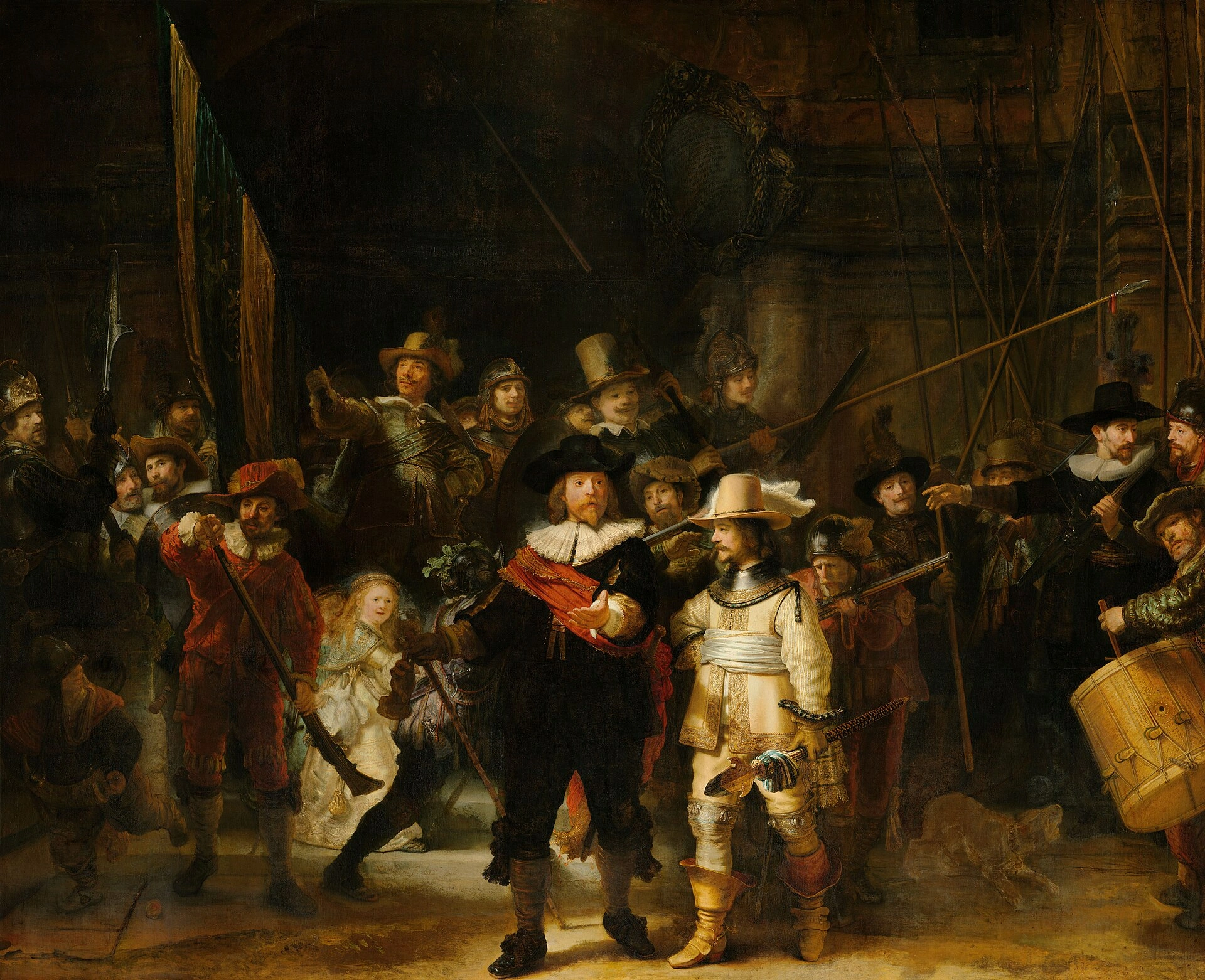
In the painting above, find the man in red on the left. Look farther left: the figures press against the edge of the canvas. Now find the two officers in front — one in black with a red sash, the other in a pale outfit. Remember where they stand in relation to the middle.
In 1715, plans were made to move Rembrandt’s Night Watch to Amsterdam’s town hall. In its new home, the painting had to fit between two doors. The canvas was cut down. The widest strip came off the left.
But how can we tell what disappeared, if the cut-off pieces have never been found? A much smaller painting holds the clue: an old copy.
A small painting remembers a large one
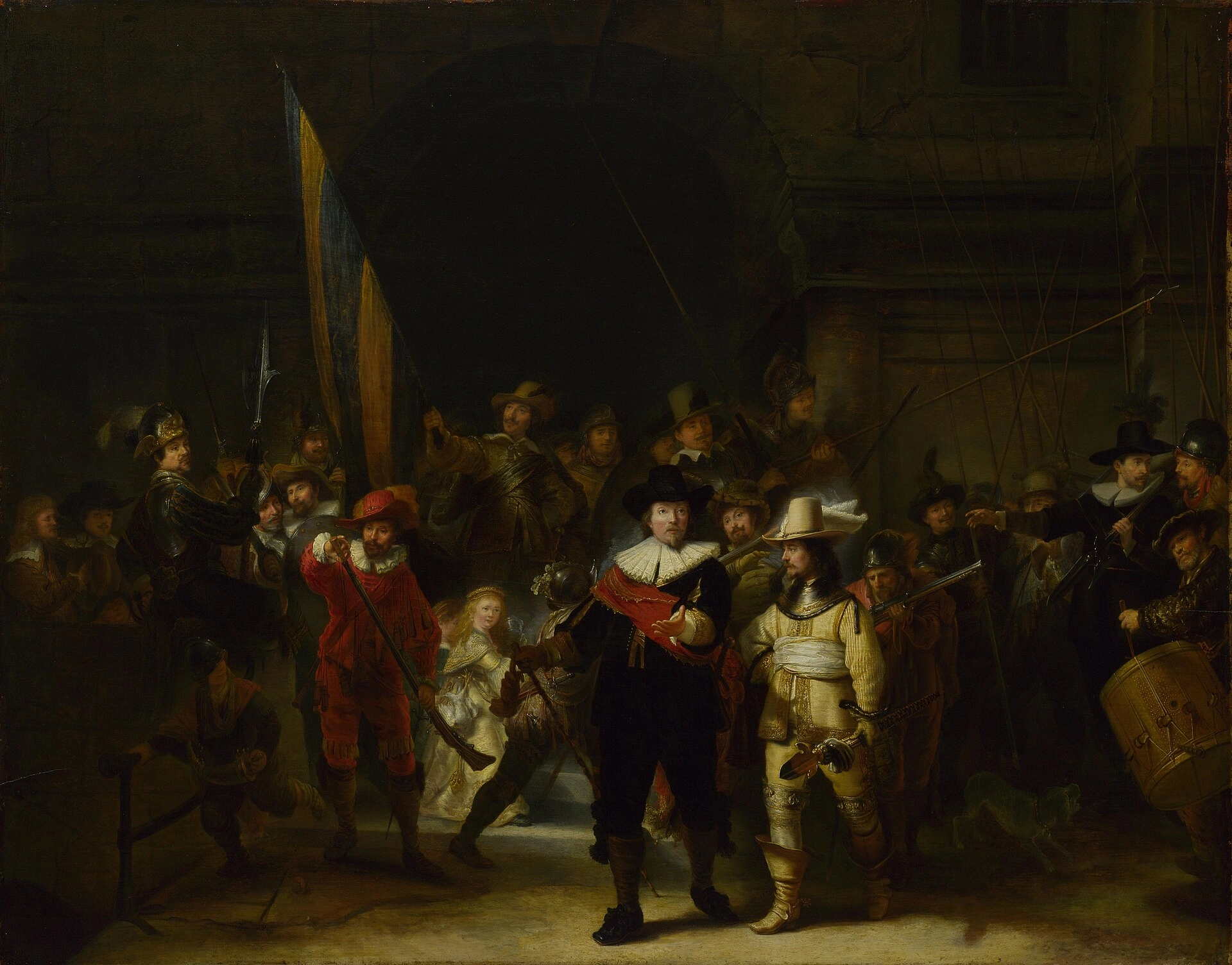
This seventeenth-century copy is attributed to Gerrit Lundens. It was painted after Rembrandt’s 1642 original, but before the cutting. The National Gallery lists its size as just 66.8 by 85.4 centimetres. Beside the enormous Rembrandt, it is almost a painting for a living room.
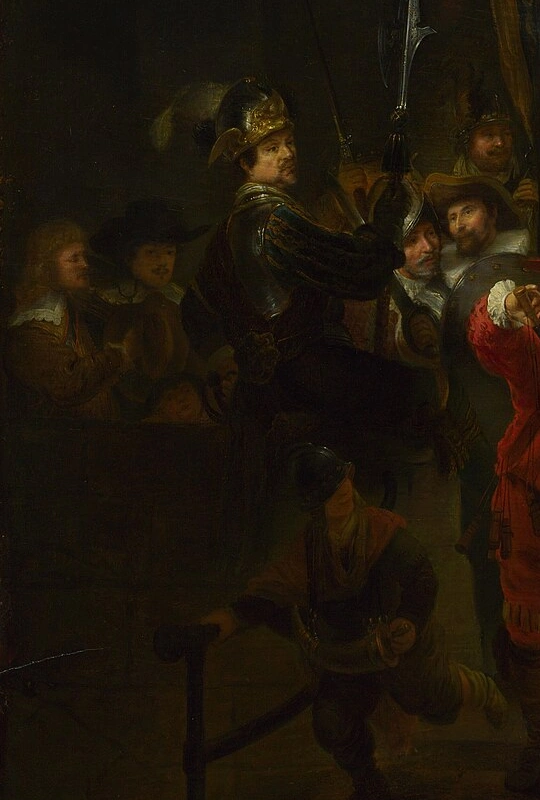
Look at the far left. Two men and a child have appeared behind the railing. They are missing from the original above. There is also more room around the drummer on the right. The copy preserves more than a different frame: it records people and gestures that physically disappeared from the large canvas.
Do not try to match every face pixel for pixel. This is another artist’s work. It is evidence of the earlier composition, not a substitute for Rembrandt’s missing brushstrokes.
The officers stayed. The centre moved.
Return to the two officers. In the surviving painting, they stand close to the middle. In the wider composition, they are to the right of centre. Nobody moved them. What changed were the edges from which we measure the middle.
Now find the running boy at the lower left. The copy makes his grip on the railing easier to see, and gives him space to run into. In the cropped painting, his movement almost immediately meets the edge.
Try covering the left edge of the copy with your hand. Watch the people who remain visible, rather than the ones you hide. The two officers begin to occupy a different place in the painting, although you have not touched them.
What the records actually say
An order dated 23 May 1715 called for Rembrandt’s large painting to be cleaned and moved to the small council-of-war chamber. The records do not establish who cut it, or on which day. The Rijksmuseum cautiously dates the move to 1715 or shortly afterwards.
By 1756, the town hall’s keeper, Jan van Dijk, was describing the cutting to fit between the doors and comparing the painting with the copy. Giving this story an exact date and a named cutter would add information we do not have.
Recreating the edges is not finding them
In 2021, the Rijksmuseum presented a computer reconstruction of the missing strips, based on the Lundens copy. The new sections were printed on panels and temporarily placed around the original. They helped viewers see the earlier proportions. They were not recovered pieces of Rembrandt’s canvas.
The images here are the surviving original, the old copy, and a clearly labelled detail of that copy. No missing faces have been drawn in, and the colors have not been editorially corrected.
Look back at the first painting once more. Its frame may seem different now. It is not only the boundary of an image. It marks the place where someone once decided how much room Rembrandt deserved.

